Facebook advertising does not have a fixed daily price instead Facebook ad cost is flexible and set by your budget. You choose how much you’re willing to spend per day or per campaign and Facebook will spend up to that amount. For example, Minimum recommended daily budget is about $1 for awareness/impression campaigns and $5 for conversion focused ads. These are the lowest budgets at which you can get reliable data. In practice, most businesses spend more often $20–$50 per day or higher to see meaningful results.
The actual daily spend is entirely up to you if you set a $50 day budget, Facebook will not spend more than that per day. Meanwhile, average cost metrics give a sense of pricing: typical Facebook cost per click CPC is often between $0.30 and $0.65 and cost per mille CPM, per 1,000 impressions around $1 to $3. In this article, we dive deep into all factors that influence Facebook ad cost, explain how daily budgets work, and share data-driven strategies with real stats and examples to optimize your ad spend.
How Facebook Ad Pricing and Budgets Work
Facebook ads use a pay per click auction system. You set a budget and bid manually or via Facebook automatic bidding and then your ads compete in auctions for placements. You pay only for actual results clicks, impressions or actions not upfront. The key is that your daily cost is capped by your budget.
Facebook offers two budget types Daily Budget set per day or Lifetime Budget total for the campaign. With a daily budget, Facebook will spend up to 125% of your daily average no more than your set amount in a week. Importantly, you control the spend. if your goal is brand awareness and you set a $10/day budget, Facebook will simply spend that $10 or less per day.
Because of this flexibility, businesses can start with very low spend. Many advertisers test the waters with as little as $5 to $10 per day to gather data. According to Fetch and Funnel, even $1 to $5 per day can produce useful data, especially for impressions or small scale tests. As campaigns grow, you can scale budgets up to any amount.
Metrics: Facebook charges by various metrics:
-
CPC Cost Per Click: You pay only when someone clicks on your facebook ads. Average CPC on Facebook hovers around $0.26–$0.65 though it can be higher in competitive industries.
-
CPM Cost Per Mille: You pay per 1k ad impressions. Average CPM is roughly $1 to $3 making Facebook relatively affordable for reach.
-
CPA Cost Per Action Lead Sale: You pay when a user completes a desired action signup, purchase, etc. Industry reports list average Facebook cost per lead around $5 to $8.
-
Conversion Rate and ROI: Faceboo average conversion rate is roughly 9–10% meaning strong targeting and ad quality are crucial to lower your cost per result. For example, one analysis notes. if your product is $50 and conversion is 3%, you might need 33 clicks at $1 CPC to get a sale a $33 spend.
In short, your cost per day depends entirely on what you set and what results you get. Facebook will pace your spend so it uses your budget evenly, considering ad performance and time of day. This system ensures you never pay more than intended, but also rewards high-quality ads with lower costs since Facebook favors ads with strong engagement and relevance.
Key Factors That Determine Facebook Ad Costs
Several factors influence how much you ultimately pay for Facebook ads. Here are the main ones:
-
Campaign Objective: The goal you choose brand awareness, traffic, conversions, etc. affects cost. Conversion or lead-generation objectives typically cost more per action than simple awareness. Choosing the most relevant objective helps Facebook optimize spend. For example, if you want sales using a Conversions objective will cost more per click than Reach or Traffic. But it yields more valuable outcomes.
-
Target Audience Size: A broad audience means more competition. Narrowing your audience can decrease CPC. For instance, targeting all women in a country is broader and more competitive than targeting women 25-34 interested in fitness. Detailed targeting age, interests, behaviors helps reduce waste and cost.
-
Ad Quality and Relevance: Facebook rewards engaging, relevant ads with lower costs. Ads with high click-through rates (CTR) and positive feedback get a better relevance score, which means you pay less per result. Conversely, poorly targeted or stale ads waste budget. Always match your ad content to your audience’s interests to keep costs down.
-
Bidding and Optimization: Your bid strategy automatic vs. manual and optimization settings also impact cost. Automatic lowest-cost bidding aims to get the most results within your budget. If you set a manual bid or a target CPA, Facebook will pace spending to hit those targets. Whatever you set, Facebook will never exceed your total budget.
-
Placement: Ads can appear in News Feed, Stories, Marketplace, Instagram, Audience Network, etc. Different placements have different demand and pricing. Often, News Feed and Stories are more expensive than Marketplace or Audience Network.
-
Competition and Industry: Some industries naturally have higher ad costs. For example, legal and finance advertisers often pay several dollars per click, whereas retail or apparel might pay under $1. Seasonal demand also spikes costs Q4 holiday season tends to raise CPMs and CPCs by 20–50% due to higher competition.
-
Ad Schedule & Frequency: If you run ads constantly to the same users, ad fatigue can set in. Lowering frequency or refreshing creatives regularly prevents engagement drop-off, which otherwise would increase your cost per click since bored users stop interacting.
In summary: Facebook ad cost per day is not fixed it’s the outcome of these combined factors. By understanding them, you can estimate and influence your costs. For instance, targeting a highly specific audience in a low competition niche with a $50/day budget will have much lower CPC than a broad audience in a competitive market at the same budget.
Typical Facebook Ad Cost Benchmarks
To plan effectively, it helps to know some industry benchmarks. While your results may vary, here are average figures as of 2024–2025:
-
Average CPC: ~$0.30–$0.65 some reports say $0.26–$0.50. Highly competitive sectors finance, insurance can see $3–$4 CPC while many consumer industries run below $1. A 2017 analysis found the overall average Facebook CPC around $1.72 but costs have since come down with improved ad quality and competition.
-
Average CPM: Around $1–$3. This means getting 1k ad impressions often costs only a few dollars. However, after Q4 or during big events, CPMs can surge due to higher demand.
-
Average CPL (Cost per Lead): Roughly $5–$8 in many industries. Again, costly products like a demo request for enterprise software will be higher than a free trial sign-up.
-
Average CTR: About 0.9% across all industries. High-CTR 1%+ ads tend to be cheaper per click because Facebook rewards them with better placement.
-
Average Conversion Rate: Facebook often sees conversion rates around 9–10%, depending on industry. Higher conversion means lower cost per sale.
Meta Ads CPC: Since Facebook is part of Meta ads platform with Instagram, Messenger, etc., Meta ads cost per click is effectively the same metric. Benchmarks for Meta ads CPC are similar roughly $0.30 to $0.65 on average. One study compiled Meta advertising data and found CPCs in that range, varying by region North America a bit higher, $0.40 to $0.65 Europe $0.30 to $0.50.
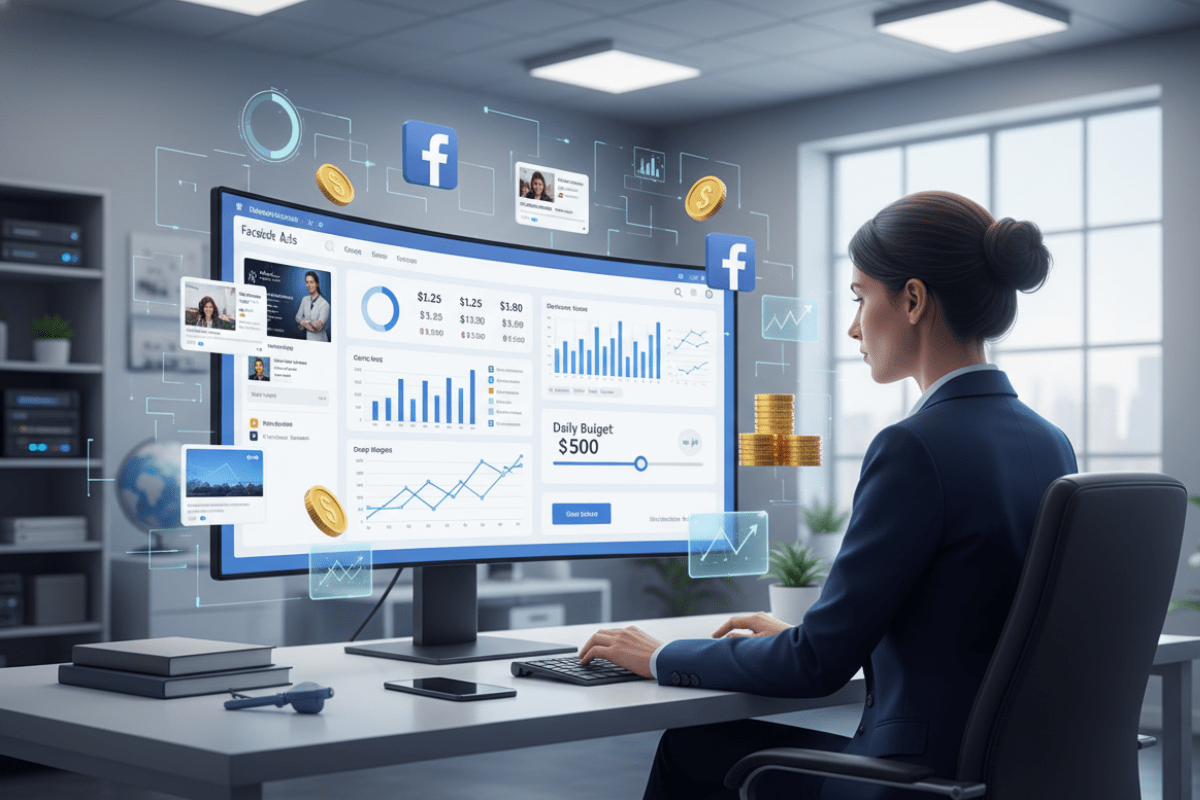
Remember: these are averages. Your daily Facebook ad spend could be much lower or higher based on your goals. Even if your CPC is $0.50, spending $5 day yields 10 clicks day hence 300 clicks month. If one in ten clicks converts, that’s 30 actions at a cost of $5 each but if you improve targeting and boost conversion. Your effective cost per sale can drop dramatically.
Example: A small business selling a $50 product with a 3% conversion rate needs 33 clicks for one sale. At $1 CPC, that’s $33 in ad spend to gain $50 revenue. By optimizing ads to lower CPC e.g. to $0.50 and improve conversion say 5% cost per sale falls significantly to $17 per sale.
Setting and Optimizing Your Daily Budget
Since the daily cost is self-determined key question becomes How much should I budget per day? Here are guidelines:
-
Minimum Recommended Spend: For campaign learning and stability, experts suggest at least $5/day for conversion campaigns. This gives Facebook algorithm data to optimize. For awareness campaigns, $1 to $2 per day can work, but expect slower results.
-
Scale with Goals: If your goal is one sale per day, calculate roughly how many clicks or impressions you need and at what cost. For instance, if your sales funnel needs 20 clicks at $1 each, that’s $20/day. Adjust up or down as performance dictates. Many new advertisers start at $10 to $20/day and increase once the ads are profitable.
-
Daily vs. Lifetime Budget: Use a daily budget for consistent spend, and lifetime for fixed periods like a 2-week sale. Facebook recommendation with a daily budget. Your spend can fluctuate slightly up to 125% some days to optimize results, but averaged over the week it stays on budget.
-
Monitor and Adjust: Track your metrics. If you see very low reach or clicks after a day or two, consider increasing the budget. If costs are high with low returns, try pausing and refining your targeting or creatives before spending more.
Example: Suppose your goal is 10 leads per day, and your current Cost Per Lead is $8. You’d need $80/day. If you set a $100/day budget Facebook will spend up to that amount daily for those 10+ leads or until the budget is hit. If you only have $20/day to start, expect 2–3 leads/day at those rates use the data to refine the ads.
Always remember: you control the daily ad cost by your budget. If you want to spend less on a particular day, just lower the budget. Facebook won’t charge more than you set.
Tips to Lower Facebook Ad Costs
Even with great targeting, keeping Facebook ad cost per day efficient requires ongoing optimization. Below are proven strategies backed by industry experts to lower your cost per result:
-
Choose the Right Objective: Align your campaign goal with your business goal. For sales, use Conversions or Catalog Sales rather than Reach. Picking a mismatched objective e.g. using Reach for sales wastes money on low-value clicks.
-
Narrow Your Audience: More focused audiences face less competition. Use Facebook’s Audience Insights to target specific demographics/interests. For example, instead of all women 18–50, target women 25 to 40 interested in fitness and healthy food. This precision often cuts CPC.
-
Rotate Creatives Regularly: Don’t let users see the same ad over and over. High ad frequency leads to fatigue, lowering CTR and raising costs. Refresh your images/videos and copy every few days or weeks. Test different ad formats video vs. carousel and placements mobile vs. desktop to keep engagement high.
-
A/B Test Diligently: Run split tests on creatives, headlines, and audiences. Change only one element at a time so you know what drives performance. For example, test two images with identical copy, or two audience segments with the same ad. Use Facebook’s A/B testing tools to compare results. The winning variant will improve CTR or conversion, effectively lowering cost per result.
-
Ensure High Ad Relevance: Make sure your ad copy and creative closely match what you’re targeting. Irrelevant ads e.g. promoting men’s products to women score poorly and cost more. Keep messaging clear and on-point. Facebook’s algorithm favors ads with higher relevance, giving them cheaper placement and lower CPC.
-
Use Retargeting and Lookalike Audiences: Retargeting (showing ads to people who visited your site or engaged before) often yields much lower costs and higher conversions. Similarly, Facebook Lookalike Audiences let you reach new users similar to your best customers at a relatively low cost. These strategies focus spend on warm or high-potential audiences, boosting ROI.
-
Optimize the Landing Page: The ad’s journey doesn’t end at the click. A fast, relevant landing page keeps conversion rates high. Slow or confusing pages make users bounce, meaning you paid for a click that never converts. Improve page load time and clarity to maximize the value of each click.
-
Leverage Broad Advantage+Targeting Carefully: Meta’s Advantage+ formerly Automated Targeting can help find lower-cost impressions, but it should be used with a bit of initial targeting guidance. Start with clear customer data and let Facebook optimize within those parameters.
-
Hire Expertise : If managing costs is overwhelming, an experienced Facebook ads specialist can help. Agencies or consultants often know the latest tactics to squeeze more value from your budget.
By applying these tips, many advertisers see their average CPC and CPA drop significantly. For instance, one company reduced CPC by 30% simply by improving audience targeting and creative freshness. Always watch your analytics small incremental improvements add up to big savings.
FAQs about Facebook Ad Costs
Q: How much does a Facebook ad campaign cost per day?
A: You set the daily budget cost per day is flexible. It can be as low as $1 to $5 per day for minimal campaigns or anywhere higher depending on your budget. Facebook will spend up to your set budget each day. For example, if you set a $50/day budget, that is the maximum it will spend per day. Choose a budget that aligns with your goals e.g. number of clicks or conversions you want). Most advertisers find $5 to $50/day a good starting range, scaling up as performance improves.
Q: What is the average Facebook ad cost per click (CPC)?
A: Average Facebook CPC usually falls between $0.30 and $0.65. This is generally lower than many other channels. Of course, exact CPC depends on industry and targeting some niches like financial services see $3–$4 per click, while others apparel, retail often pay well under $1. Your own CPC will depend on your competition and how well you optimize ads.
Q: What is the average cost per day for Facebook ads?
A: There is no set per day rate it’s your budget. However, industry data suggests small businesses typically spend $5 to $25 per day initially. Many advertisers report $10 to $50/day as a sweet spot for testing and decent results. If you have a very limited budget Facebook minimum daily spend around $1 to $5, depending on objective applies. But for meaningful reach and conversions, plan to invest at least a few dollars per day.
Q: Are Facebook ads expensive?
A: Compared to many platforms, Facebook ads are relatively affordable. Meta itself notes that Facebook is among the most reasonably priced digital marketing channels. Because you control the budget and can target narrowly, you can often achieve good ROI even with modest spend. In fact, 81% of businesses say they get a positive ROI from Facebook ads, showing that careful optimization targeting, creative, bidding can make Facebook highly cost-effective.
Q: How can I reduce my Facebook ad spend?
A: Focus on efficiency refine targeting, improve ad relevance, and test variations. Narrow your audience to qualified users, A/B test ad creatives and ensure your ads match your audience’s interests. Use retargeting for cheaper conversions and optimize your landing pages. Continuously monitor ad frequency to avoid fatigue. Each of these steps tends to lower CPC/CPM, making your daily budget more efficient.
Conclusion
In summary, Facebook ad cost per day is highly flexible and depends on your chosen budget and campaign details. You can start with as little as $1 to $5 per day and scale up as you find success. On average, Facebook’s cost per click remains low under a dollar and the platform offers powerful tools to control spend. Key to managing your ad cost is smart targeting, relevant creative, and ongoing testing. By applying the strategies above such as narrowing your audience, optimizing ad quality, and fine-tuning bids you can stretch every advertising dollar and maximize ROI.
Ultimately, Facebook ad cost is not a one-size-fits-all figure it is something you define through your budget and strategy. Keep an eye on your metrics CPC, CPM, CPA and adjust accordingly. With the right approach, even a modest daily budget can deliver results.
See More Post: How to Make Money on YouTube for Beginners in 2025
1 thought on “How much do Facebook ad cost per day”